
Case 4: Iași, Romania:
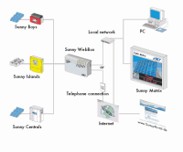
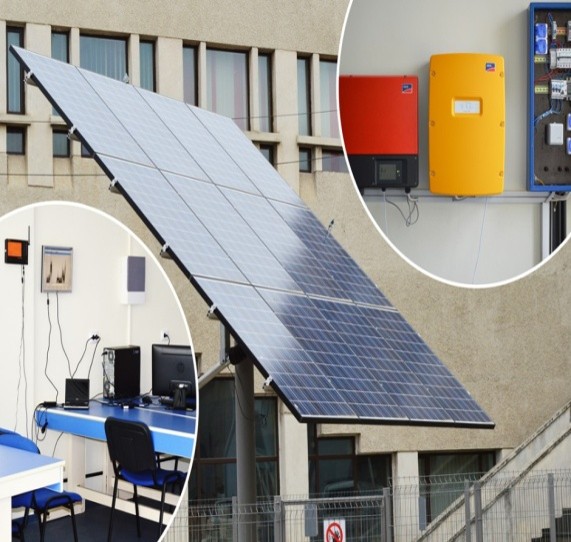
The university has an experimental area of photovoltaics, associated to a local climate center for environmental monitoring and predictions, along with all related hardware and software for energy management and expert systems for strategies towards zero energy areas. The university also has a production energy facility in co-generation and other renewable energy facilities possible to be integrated in a smart urban area. The expertise from previous projects will be expanded by integrating the energy facilities and creating a larger smart urban area of the university campus. The campus also has a strong IT dept. with expertise in energy management related software.



Main objectives
(1) new technological solutions for retrofitting by using economic materials from recyclable sources;
(2) use expert systems and smart communication channels to set effective behavioural change incentives when it comes to energy-efficient use in a specific academic campus (as innovative use case, comparing to the others use cases);
(3) collect specific success factors and barriers for energy efficiency in a pre-defined neighbourhood of a larger smart urban area of the university campus, in a multi-level perspective
(4) contribute to the community of practice between the demo sites to exchange on barriers, enabling factors, success factors for implementation of technologies and social innovation, good practice examples of co-creation with citizens and stakeholders and for discussing and evaluating aspects around transferability of approaches and solutions as well as feeding the CoP findings back into the local context of Iasi – large university city.
Key challenges tackled
1. Developing a structured approach to identify requirements, legal pre-conditions and regulatory frameworks
2. Defining the success factors for energy efficiency and related requirements and needs of Positive Energy Zones – PED, in relation to current influencing factors
3. Sharing existing knowledge and experience regarding implementation procedures of use-case 4 among the NEEDS Repowered sites
4. Developing the NEEDS Repowered Replication Plan, to be focused on systematically reproducing successful strategies and interventions developed at pilot sites to broaden their impact across various local conditions, social dynamics, and economic landscapes.
5. Translating project results into policy recommendations
Addressed Needs
The solution should progressively integrate 11 large faculties (with amphitheatres, laboratories, seminar rooms, libraries, pilot stations, cafeterias, and outdoor facilities), and a large student campus with all facilities. It is estimated to finally impact about 56 large buildings.
The electric energy efficiency should involve smart outdoor/street/alleys/parking lightning, along with intelligent lightning within buildings.
Charging stations for electric mobility are also considered.
The pre-defined energy efficiency indicators will be regularly checked: Evaluation of heat (energy) losses vs. rehabilitation investment per m² of effective building area; Evaluation of the yearly energy demand costs when using software for energy management; Renewable energy savings vs. costs of power from external grid.
The reduction of CO₂ emissions by use of energy efficiency policy will be monitored with the help of Environmental Protection Agency.
Approach and implementation steps:
1. Analysis of good practices for the transition to a sustainable energy system, with the definition of success factors for energy efficiency
2. Requirements and needs of Positive Energy Zones – PED in relation to current influencing factors
3. Analysis of good practices for the transition to a sustainable energy system – establishing a community of good practices between the pilot / demo locations of the project
4. Implementation of the energy efficiency strategy, with customization for the pilot location of the Technical University of Iasi
5. Demonstration of the integrated energy solution at the pilot location of the Technical University of Iasi (hardware and software)
6. Developing technical solutions for rehabilitation and thermal insulation by using economical materials from recyclable sources
7. Defining sustainable policies to mitigate energy vulnerability
8. Defining a plan to replicate the results obtained at the pilot location based on the analysis of success factors
9. Collecting, structuring and translating project results into energy policy recommendations
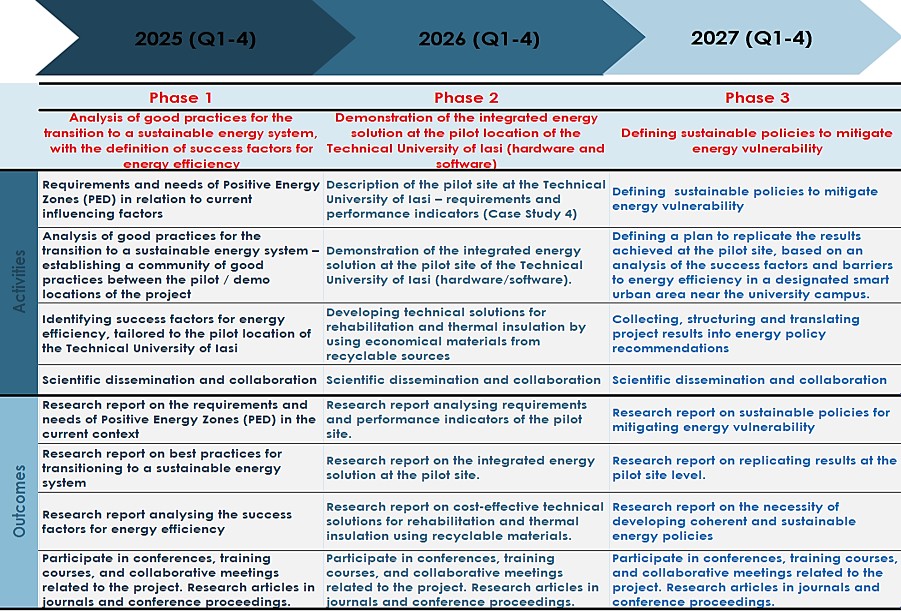
Planned Activities and Future Actions (timeline)